Monday, October 3, 2011

Nephilim: Lessons from Babel

Escher's Tower of Babel, Photo By twak

“Come, let us build ourselves a city, and a tower whose top is in the heavens; let us make a name for ourselves, lest we be scattered abroad over the face of the whole earth.” - Genesis 11:4

In the well known account of the Tower of Babel, in Genesis 11:1-9, the people of Babel sought to build a tower to reach heaven, to make a name for themselves, and to protect themselves from being scattered over the face of the earth. God comes down and confuses the language of the people so that the building project ceases and their efforts are thwarted. Most of us are familiar with this story as a rationale for why the human race has different languages and cultures. What we may miss is that this account is about so much more.

The Tower of Babel is about sin and its consequences and the continuation of the fallen nature of humankind in the world after The Garden of Eden, and after Noah and the flood. When we read about Babel, we see humankind in the same condition as they are after the fall, and as we continue to be today. Many of us look at Babel with the same confusion that defines the name “Babel” itself. We think, “What’s the big deal? What is God’s problem? What is wrong with wanting to be in heaven? What is wrong with unity? Why can’t I have a decent name for myself?” Okay, we may concede, on a good day, that making a name for ourselves may be vain and arrogant, but what about the rest of this?

Here are three lessons we can learn from Babel:

  1. A heaven without God is no heaven at all.
  2. There is only one name we should be concerned with, and it is not our own.
  3. Unity without connection to God is unity not worth having.

Let us look at this quest for heaven first. Notice the people of Babel do not say that they are attempting to get to God. Genesis 11:1-9 does not mention any concern by the people of Babel for God. In fact, they never mention God at all. We get the impression that this tower is to be “giant” and impressive and reach into the sky, not that it will “achieve God,” or reach God’s “Heaven.” The Hebrew word used for heaven here, (H8064) shamayim, has the root meaning, “to be lofty.” It is most likely the first definition of (H8064) shamayim, “heaven, or heavens, the sky; the visible heavens, as abode of the stars, as the visible universe, the sky, or the atmosphere (Strong).” The heaven here is one of “their own making.” This is a Godless heaven, if you will, and a heaven without God is no heaven at all.

Next, let us look at what is in a name. The quest for a name for ourselves is a quest of identity, belonging, and trust. It can also be a quest for adoration. This was the issue with Adam and Eve trusting God in the Garden paradise. Adam and Eve did not trust their identity in God. Adam and eve wanted to “be like God,” knowing good from evil. They felt they could love themselves better than God could. They did not trust that God had their best in mind and they sought out their own best. They sought their identity and existence outside of God, out on their own. They did not trust God. Adam and Eve sought to love themselves over and beyond loving God in obedience. Their love for self left no love for God. In effect, they made themselves their own gods.

There were people in ancient Biblical times named Nephilim. The Nephilim were giants that lived in the land before Noah and the flood. These giants were notorious and the people of Babel wanted to be just like them, “Giant.” The people of Babel arrogantly wanted to make a name for themselves. The irony is that the land of Shinar that the people of Babel were settling in to build their tower is also thought to be the same location of the Garden of Eden where Adam and Eve sought to be “Giant” as well; all alone, and without their God.

Adam, Eve, and the people of Babel’s names became more important than the name which is above every name. As Paul said, “At the name of Jesus every knee should bow, of those in heaven, and of those on earth, and that every tongue should confess that Jesus Christ is Lord, to the glory of God the Father (Philippians 2: 10-11).” This focus on our own names and ourselves leads us to destruction. It led to Adam and Eve’s deaths and the world being fallen, it led to the destruction of Babel, and it will lead to our own demise. There is only one name we should be concerned with, and it is not our own.

The last thing the people of Babel sought was security and comfort in their unity. This was “safety in numbers” taken to the extreme. Instead of seeking unity, security, and comfort with and in their creator and worshiping God, they sought unity with each other. The people of Babel began to worship one another in essence. They were worshiping the creation, and they worshipped at the altar of humanity instead of worshiping the creator who made them and in whom we have all things (Romans 1:24-25, all).

Timothy Keller talks about the way we make idols out of others and ourselves when he says, “Our need for worth is so powerful that whatever we base our identity and value on we essentially 'deify.' We will look to it with all the passion and intensity of worship and devotion, even if we think ourselves as highly irreligious (Timothy Keller).” When our unity becomes our security, our unity becomes our god. When other people and our unified relationships with them become our comfort, or our identity, then God is not our comforter or our identity, and our comfort and our identity do not come from God. We in effect create idols out of one another and ourselves. This unity we should never seek out. Unity without connection to God is unity not worth having.

The confusion of Babel is not over. We are still tempted to be Nephilim, “giants.” We seek heaven on our own terms; we seek to make a name for ourselves; and we seek security and comfort in unity, all apart from the God who is Nephilim. It is God who is Giant! May we seek God and worship God alone realizing a heaven without God is no heaven at all, that there is only one name we should be concerned with, and it is not our own, and a unity without connection to God is unity not worth having.


Works Cited

Strong, James: The Exhaustive Concordance of the Bible : Showing Every Word of the Text of the Common English Version of the Canonical Books, and Every Occurrence of Each Word in Regular Order. electronic ed. Ontario : Woodside Bible Fellowship., 1996, S. H8064

The New King James Version. Nashville : Thomas Nelson, 1982, S. Ge 11:1-9

Tuesday, September 13, 2011

Jacob Deceiver

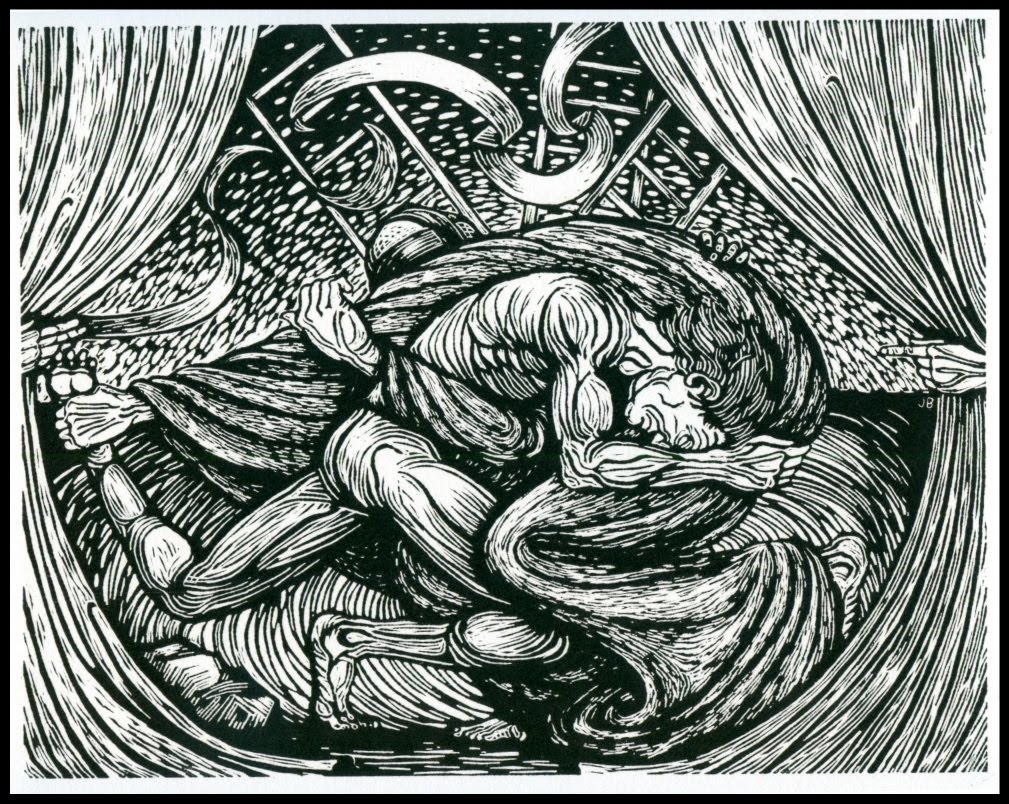
Photo of Jacob Wrestling the Angel of God, by Jack Baumgartner, ©2009

Photo Courtesy of the author Jack Baumgartner

Jacob Deceiver

Guest post by Anna Rose O’kelley, © September 7, 2011

Genesis 32: 22-32: Wrestling with God

“And he arose that night and took his two wives, his two female servants, and his eleven sons, and crossed over the ford of Jabbok. He took them, sent them over the brook, and sent over what he had. Then Jacob was left alone; and a Man wrestled with him until the breaking of day. Now when He saw that He did not prevail against him, He touched the socket of his hip; and the socket of Jacob’s hip was out of joint as He wrestled with him. And He said, “Let Me go, for the day breaks.” But he said, “I will not let You go unless You bless me!” So He said to him, “What is your name?” He said, “Jacob.” And He said, “Your name shall no longer be called Jacob, but Israel; for you have struggled with God and with men, and have prevailed.” Then Jacob asked, saying, “Tell me Your name, I pray.” And He said, “Why is it that you ask about My name?” And He blessed him there. So Jacob called the name of the place Peniel: “For I have seen God face to face, and my life is preserved.” Just as he crossed over Penuel the sun rose on him, and he limped on his hip. Therefore to this day the children of Israel do not eat the muscle that shrank, which is on the hip socket, because He touched the socket of Jacob’s hip in the muscle that shrank.”

The New King James Version. Nashville : Thomas Nelson, 1982, S. Ge 32:22-32

Jacob Deceiver

This story is one of the stranger stories in the Bible. It’s one that I think is skimmed over a lot. But I would like to share what I think it means.

The story of Jacob starts when Rebekah and Isaac have two twin boys. The eldest son is named Esau who is born moments before his younger brother Jacob. Jacob’s name means deceiver. From the time he is born, Jacob has a certain identity thrust upon him by his own parents. From the very second that he came out of his mother’s womb he was called by the name of “Heel Grabber,” or “Supplanter,” or “Deceiver.” That was his identity, someone who takes the place of another. As Jacob grows up, he doesn’t trust that God could possibly have anything else in mind for him. He takes on the responsibility of his destiny by himself. He doesn’t trust that God might have a different identity than the one that the world has been taunting him with since the moment he was born.

Living up to his name, Jacob deceives his own brother out of his birthright. He deceives his own Father out of his blessing that was meant for the eldest son, and Jacob seeks to take the place of his older brother. This all comes back to haunt him, however, when Jacob is deceived by his own future Father in law when he is trying to marry his future wife Rachel. Jacob gets the older daughter instead of the younger, in an ironic twist of fate, and has to work another seven years for Rachel. Jacob later tricks his Father-in-law and steals his wealth and flees, enacting revenge and again living up to his name.

Jacob is consumed by this deception identity that he has been given. He is painfully aware of his name. This leads us to one fateful night. One night a man comes to Jacob and he and Jacob begin wrestling together. They fight and they fight until daybreak. When “the man” sees that Jacob is not giving up, he supernaturally touches Jacob’s hip and miraculously dislocates it, yet Jacob still will not give up. The man says to Jacob, “Let me go, for it is daybreak!” but Jacob says, “I will not let you go until you bless me!” By now you may have guessed that the person Jacob is wrestling with is God. Jacob also recognizes that this is God he is wrestling with.

After this life of accepting people’s opinions and titles for him and people’s false identities for him, Jacob is now face to face with God and saying “I will not let you go until I receive your blessing and until I receive my identity from you!” God looks at Jacob and he asks a simple question, He says, “What is your name?” There is a long pause, I imagine, and the word comes out with a bitter taste and a sigh… “Jacob…” Jacob says… “My name is Jacob. My name is deceiver, liar, and coward. My name is Jacob and this is who I am.” And with that, God looks lovingly at Jacob and says, “Because you have struggled with your identity in man, and now you have struggled with God, you have overcome. Now I will give you a new name. Your name is…Israel.” This name means struggling with God.

As the account draws to a close, we watch as Jacob shakes off the judgment that has clouded over him his whole life. He finally takes on the identity that God had for him all along. And as he lets go of his old name, a peace that he has never felt before floods over him and he is transformed by the renewal of his mind.

Saturday, September 10, 2011

Jacob Wrestling the Angel of God - Art Review

Photo of Jacob Wrestling the Angel of God, by Jack Baumgartner, ©2009
Courtesy of the artist, Jack Baumgartner

To see more of Jack Baumgartner’s work visit his Web site here: http://theschoolofthetransferofenergy.com/

Jack Baumgartner - Jacob Wrestling the Angel of God, 2009
Art Review by Robbie Pruitt, © September 2011

Jack Baumgartner's Jacob Wrestling the Angel of God is a compelling work of art that draws the viewer in. There is an enticing motion that circles about in the way this lithograph is constructed. We can see the movement and can almost feel it. The wrestling match is in full swing and we get a glimpse into the scene as hands from either side draw back the curtain revealing the wrestler and his God. One of the hands point to what is transpiring before us as the curtain is held. It is as if the author of scripture is opening up this time and place to us. We are not just watching the wrestling match; however, we also see a reminder of God’s other dealings with Jacob in the ladders that are crisscrossing the rear of the scene. In the ladders we get a flashback to Jacob’s dream of the ladder bridging heaven and earth, and a foreshadowing the cross, our Jacob’s ladder. A closer look also reveals God’s grip on Jacob’s ankle. God has placed His grip on Jacob’s wound. Jacob has been grasping for blessing and identity ever since he grabbed his brother Esau’s ankle from their mother’s womb. Now, God pulls Jacob back by his ankle in a twist of fate and forces his knee to bow at His presence and at the stone Bethel, the house of God. It is as if God desires to go before Jacob to affirm a new identity in God’s own self. As for us, we never see the end of the wrestling match in Baumgartner’s work. What we do see is movement that is almost perpetual, as if wrestling matches with God and man never end. Jack Baumgartner captures movement, beauty, and the narrative of scripture in his work. He does the scriptures justice and helps them come alive.