Friday, August 12, 2011

Do You Know What You Are Reading?

Photo: On the platform, reading, by moriza

Recently I purchased a Haitian cell phone so that I could communicate while in Haiti. To my surprise and dismay, I discovered French instructions to the phone when I cut it on. I don’t read French. At that point, the phone might as well have been a paper weight. It was useless to me. I knew what I was looking at was a welcome screen. I even guessed what it was probably saying, but I had no idea of what the actual message was. I was confused.

This got me thinking about the Bible. Many of us are looking at our Bibles this exact same way, and we are confused. We sit there with our “glorified paperweight” and we have no idea of the magnitude of the message we have before us.

Just as I did not understand my phone message and its instructions, many of us do not understand what we are reading when we read the Bible. As a matter of fact, one of the most common responses to the question “Why don’t you read your Bible?” is “I do not understand what I am reading.” Maybe you have felt like this before. I know I have. Not just with my Haitian cell phone, but with my Bible as well.

In Acts chapter eight, there is a wonderful record of Philip encountering an Ethiopian eunuch through the nudging of an Angel of the Lord. As Philip was traveling, he was instructed to go down the road toward Gaza. While traveling in this desert area, Philip came across the eunuch who was reading Isaiah. Acts records the account like this: “So Philip ran to him, and heard him reading the prophet Isaiah, and said, ‘Do you understand what you are reading?’ And he said, ‘How can I, unless someone guides me?’ And he asked Philip to come up and sit with him (Acts 8:30-31).”

This is an amazing occurrence of spontaneous Bible teaching from the scriptures. The outcome is equally amazing. Philip entered the eunuch’s chariot and explained to the eunuch that what he was reading in the Old Testament scriptures was in fact about Jesus. The passage, from Isaiah 53:7-8, was a prophesy of Christ’s crucifixion. “The eunuch answered Philip and said, ‘I ask you, of whom does the prophet say this, of himself or of some other man?’ Then Philip opened his mouth, and beginning at this Scripture, preached Jesus to him (Acts 8:34-35).”

When I was fumbling with my cell phone and nothing was making sense to me, a friend of mine, who also happened to know French, came to my rescue. He took my phone, understanding what it said, and made some adjustments so that I too could comprehend what it was saying. On a much grander scale, this was what occurred between Philip and the Ethiopian eunuch. It was at the hearing of the explanation of God’s word that everything changed for the eunuch. The account continues with the eunuch becoming a follower of Jesus. He responded: “I believe that Jesus Christ is the Son of God (Acts 8:37).” Then, he was baptized.

Understanding what we are reading in scripture is vital! Do you understand what you are reading? Do you believe that Jesus Christ is the Son of God?

Tips for understanding what you are reading in scripture:

  1. Before you read scripture, ask God to reveal Himself to you by His Spirit.
  2. Seek Jesus within the pages of the Bible.
  3. Read the Bible with someone more knowledgeable than you are and discuss it.
  4. Go to Bible studies at a local church or look up lectures online from a credible church.
  5. Ask questions of the scriptures and other people who are wiser than you.
  6. Go to the Bible with a dictionary in your hand and look up words that you don’t know.
  7. Use the internet and go to online resources that are dependable like: http://www.biblegateway.com/, http://www.blueletterbible.org/, http://www.e-sword.net/, http://www.followtherabbi.com/, www.gotQuestions.org, and there are many others.

The New King James Version. Nashville : Thomas Nelson, 1982, S. Acts 8:26-40

Monday, August 8, 2011

A Problem with Reading the Bible


Flikr3032, photo by flikr

One of the biggest problems we face in reading scripture is missing Jesus.

If we read the Bible and do not see Jesus within the pages, we have missed the message completely. Jesus speaks to this in John 5:39-40 when he was addressing the Jews and their understanding of the Old Testament scriptures, or Torah. Jesus said to them, You search the Scriptures, for in them you think you have eternal life; and these are they which testify of Me. But you are not willing to come to Me that you may have life (John 5:39–40).”

The Jews had familiarized themselves with the scriptures and were even looking for salvation by reading them, but they missed Jesus within the pages. Jesus pointed out that the Jews thought they would have salvation in the pages of scripture. They gave themselves to the scripture, but not to the message. They committed a sort of “Bible-Idolatry” by worshiping the text instead of God revealed in the text. When it is clear, the scriptures are pointing to Jesus. The Bible is literally calling His name and calling us to Him. If in reading the Bible we do not come to Jesus for the life He offers us, we have read the Bible in vain and we have read it wrongly.

In the gospel of Luke, chapter 24, Jesus reveals Himself after His resurrection to two men walking on the road to Emmaus. The men were talking about all that had happened in Jerusalem concerning Jesus and were confused and sad. As the men were talking, Jesus approached and inquired about what they were talking about, but the men did not know it was Jesus. They told Jesus all about the crucifixion and they were distraught. They said that they had “hoped” Jesus would redeem Israel. They missed Jesus.

Jesus responded to them, “O foolish ones, and slow of heart to believe in all that the prophets have spoken! Ought not the Christ to have suffered these things and to enter into His glory?” And beginning at Moses and all the Prophets, He expounded to them in all the Scriptures the things concerning Himself (Luke 24:25-27).” The men did not understand what the scriptures had said of the crucifixion and resurrection and they did not understand that they were talking and walking with the Risen Lord Jesus. They had missed Jesus in scripture and were missing Him in the flesh, until He opened their eyes.

Jesus’ explanation of the scriptures to the men on the road to Emmaus is important. He was instructing them, and is instructing us, that all the scriptures concern Himself. One of the greatest resources that have come out in a while is The Jesus Storybook Bible, by Sally Lloyd-Jones. The subtitle of this book basically echoes what Jesus told the men on the road to Emmaus: “Every Story Whispers His Name.” This is the Bible in its essence. The Bible is about Jesus. Every account in scripture points to Him. If we miss this, like the Jews in Jesus’ day from John 5, then we will completely miss God’s message to us.

May we hear every story in scripture whisper the name of Jesus and would we find our life in Him.

Here are some basic facts that allow us to read and think about the Bible rightly:

  1. If we miss Jesus in the pages of the Bible, we have missed the message
  2. All of scripture leads us to Jesus
  3. We must not value scripture above Jesus
  4. The Old Testament, the Torah and the Prophets, point to Jesus
  5. Old Testament prophesies and the writings of Moses are fulfilled in Christ
  6. The New Testament reveals the Old Testament telling the singular narrative of salvation in Christ
  7. It is better to look at the Bible, not as the “Old” and “New” Testaments, but as a “Whole Testament”


The New King James Version. 1982 (Jn 5:39–47). Nashville: Thomas Nelson.

Sunday, August 7, 2011

The Trustworthiness of Scripture

Torah, photo by Lawrie Cate

The apostle Peter denied Jesus three times (Mark 14:66–72). Many remember this monumental failure on Peter’s part. Jesus even forewarned Peter that this would happen before He went to the cross (Matthew 26:34). However, we see a completely different Peter than this in the book of Acts when Peter leads about three thousand to Christ publicly (Acts 2). Where once we saw Peter looking out for himself or looking at lesser things, we now see him looking at Jesus.

The account of Peter’s faith is not perfect, but it is real. If you were making up a story, you wouldn’t want to include a lot of what Peter did and said. Peter walked on water, but then began to sink because he looked away from Jesus (Matthew 14:25-33). Peter even cut off the high priest’s servant’s ear in the garden when Jesus was being arrested and he was rebuked by Jesus for doing so (Matthew 26:51-52). Peter tried to stand in the way of Jesus going to the cross in another account and Jesus told him “Get behind me Satan (Mark 8:33)!” Yet, Jesus chose Peter to “be the rock upon which He would build His Church (Matthew 16:13-20).”

When Peter wrote First and Second Peter, we also see a different Peter. We see his faith in the risen Lord. In 2 Peter 1:16 Peter recalls seeing the deity of Christ first hand when he witnessed the transfiguration of Jesus on the “sacred mountain” with James and John. There the disciples heard the voice of God and saw Jesus radiate with the light of His Glory and Holy Spirit. This event help solidify for Peter who Jesus is (Matthew 17:1-9). Peter recalled, “For we did not follow cleverly devised stories when we told you about the coming of our Lord Jesus Christ in power, but we were eyewitnesses of his majesty.”

Not only is Peter an author of scripture, he is also an eye witness with a firsthand account of Christ and His ministry. As he continues to write his letter 2 Peter, Peter goes on to say this about the scripture: “Knowing this first, that no prophecy of Scripture is of any private interpretation, for prophecy never came by the will of man, but holy men of God spoke as they were moved by the Holy Spirit (2 Peter 1:20-21).” Peter is acknowledging that the scriptures were written by Holy men of God who were led by His Holy Spirit.

So how do we know if the Bible is trustworthy? According to 2 Peter, we can rest in the following facts about how we can know that the Bible is trustworthy:

  1. The Bible is not a list of made up “stories,” myths, or fables
  2. First and Second Peter, and many other books of the Bible, were written by eye witnesses
  3. The Bible did not come about through private interpretation
  4. It was not through the will of man, but was the will of God that the Bible came into being
  5. God moved people to write and led them by His Holy Spirit

It is extremely assuring to rest in the scriptures with the knowledge of these facts. It is even more assuring to realize that the “messiness” of the accounts in scripture actually lend themselves to the Bible’s credibility. As evidenced in the life of Peter, the Bible is indeed trustworthy. It is trustworthy not only because it gives us the high points, but it gives us the low ones as well. The Bible gives us the whole story. It gives us the whole truth. It is indeed trustworthy.


The New King James Version. 1982 (2 Pe 1:16–21). Nashville: Thomas Nelson.

Saturday, August 6, 2011

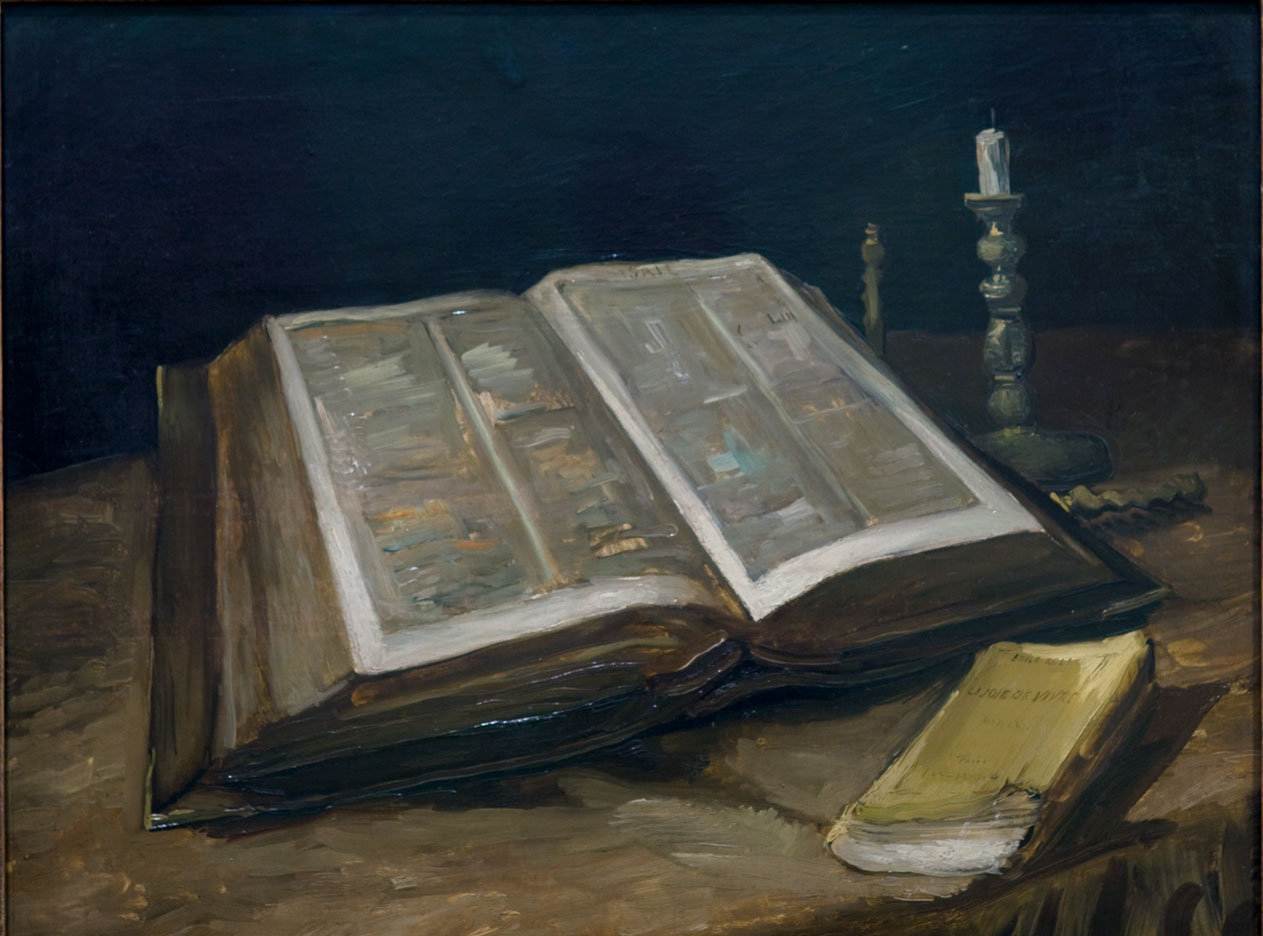
Why Study the Bible?

photo by Jan Tito on Flickr
Vincent van Gogh (1853-1890), Stilleven met bijbel, 1885,
Still life with bible


I remember when I first started reading the Bible back in middle and high school. It was complicated for me at times to understand what I was reading. I asked God in prayer to help me understand what I was reading. Sometimes I did understand and other times I didn’t.

I specifically remember reading 2 Timothy. In 2 Timothy 3: 14-15, Paul is writing to young Timothy and was instructing and encouraging him in his faith. Paul, in chapter 3 verses 14-15, says to Timothy: “But you must continue in the things which you have learned and been assured of, knowing from whom you have learned them, and that from childhood you have known the Holy Scriptures, which are able to make you wise for salvation through faith which is in Christ Jesus.”

Paul was reminding Timothy of all that he had learned and how he had grown in his faith. Most importantly, he was reminded of how he had learned through the scriptures of God’s salvation. It was in that salvation found in scripture, Paul asserted, that Timothy was made wise through his faith in Jesus.

As a high school student, I didn’t quite understand all of this and the verses that followed in 2 Timothy 3: 16-17 really threw me off. Here Paul tells Timothy that “All Scripture is given by inspiration of God, and is profitable for doctrine, for reproof, for correction, for instruction in righteousness, that the man of God may be complete, thoroughly equipped for every good work (2 Timothy 3: 16–17).”

What was Paul saying here? At first, and in my ignorance, I thought he was saying that it was profitable to correct scripture. This was probably due to the fact that as a teenager I thought the world revolved around me. This was the exact opposite of what Paul was saying to Timothy. Paul was actually telling Timothy that the scriptures are profitable for correcting him. This is also what these verses were saying to me and this is what they are telling us today.

As I look forward to teaching Bible to high school students in Haiti, I can’t help but look back on my own youthful understandings and misunderstandings of scripture. My hope is to learn even more about God’s word and to handle it and teach it rightly by God’s grace and by His Holy Spirit. Hopefully I can teach these basic concepts that Paul was teaching his young student about the Bible.

Here is some of what I hope to teach students about the Bible, what I hope is reinforced in me, and what Paul wanted Timothy to know about scripture in 2 Timothy 3: 14-17:
  1. The Bible helps us learn of our salvation and ensures us of our salvation
  2. The Bible makes us wise for salvation through faith in Jesus Christ
  3. God has given us the Bible so that we can hear from Him
  4. The Bible is profitable for doctrine (or a set of guiding principles)
  5. The Bible is profitable for reproof (or warning)
  6. The Bible is profitable for correction (God will make improvements on us)
  7. The Bible is profitable for instruction in righteousness (or right or moral living)
  8. The Bible ensures that a person is complete (or whole; integrated)
  9. The Bible helps to totally equip a person for every good work (preparation)

The New King James Version. 1982 (2 Ti 3:14–17). Nashville: Thomas Nelson.

Sunday, July 31, 2011

Idiot

Photo from the Web

I used to read the account of the Rich Young Ruler in the gospels with much pride. This account, in Matthew 19: 16-30, tells of a rich young ruler who was asking Jesus what he must do to be saved. Jesus replies in Matthew 19:21–22: “Go sell your possessions; give everything to the poor. All your wealth will then be in heaven. Then come follow me.” The scripture goes on to say, “That was the last thing the young man expected to hear. And so, crestfallen, he walked away. He was holding on tight to a lot of things, and he couldn’t bear to let go.”

I used to think, “What an idiot! This young guy would rather hold on to his riches than follow Christ? I’m glad I’m not like that!” You see, I thought that I was above riches keeping me from following Jesus. As a matter of fact, I didn’t think that I was rich. As the old song goes, “I am a man of means by no means.” At least this is what I thought, until it was Jesus asking me to “sell everything and follow Him.”

I didn't know how much I had, because I took so much of it for granted. I took the comforts of life for granted. I took running water and food for granted. I took my job, my house, material goods, technology, and all the other “basic” luxuries that I have for granted.

When God led my wife and me to sell our home and belongings and quit our jobs and follow him to Haiti, I had a staggering and sobering realization; “I am that idiot.” As it turns out, I am rich. It’s not just that I am rich. It’s that I would rather, by default and in my sinfulness, hold on tight to my “many things,” rather than follow Jesus.

Thank God that He empowers us to follow and obey despite of ourselves and even when we do not obey, God is faithful. Having sold our possessions and set up our move to Haiti, we have discovered and experienced that what Jesus has told us is true: “A man's life does not consist in the abundance of his possessions (Luke 12:15)." Our lives do not consist of what we have or do not have. Nor do they consist of what we do or do not do. We find our lives hidden in Christ Jesus (Colossians 3:1-4). Yes! Even we idiots find our lives in Him.


Peterson, E. H. (2002). The Message : The Bible in contemporary language (Mt 19:21–22). Colorado Springs, Colo.: NavPress.