Tuesday, February 8, 2011

Church of the Epiphany Partners with Souper Bowl of Caring for the Sixth Year

This past Super Bowl Sunday, February 6th 2011, Church of the Epiphany in Herndon Virginia participated in the Souper Bowl of Caring for their sixth year. The Souper Bowl of Caring is a national organization dedicated to supporting charities that feed the hungry and help the homeless across the nation and all over the globe. As of today, February 8, 2011, over five million dollars has been raised to help people in need.


The way the Souper Bowl of Caring works is through local congregations leveraging the excitement of the Super Bowl on Super Bowl Sunday by holding soup pots after Sunday services and collecting financial donations and canned goods for their charity of choice. Church of the Epiphany collected donations after their 8:00am and 10:00am services. They supported Western Fairfax Christian Ministries again this year and raised $372.00 and over 75 canned goods during their collection.


To celebrate the collection the Youth Ministries at Epiphany threw a Super Bowl Party where they collected more canned goods, watched the game, and had dinner and fellowship together. Over 47 people participated in the Super Bowl Party and Celebration and a wonderful time was had by all who participated, proving that service and celebration fit together beautifully!


According to the Souper Bowl of Caring web site, thousands of youth from churches all across the country tackled hunger on Super Bowl Sunday. Over 4,955 groups have participated so far. In 2010, youth across the country generated over $10 million for local charities through the Souper Bowl of Caring. In 2011, they hope to mobilize even more youth and generate even more money for those in need.


No matter the size of your congregation, or of your youth group, you can help provide shelter to the homeless, food to the hungry, and compassion to the needy by joining the Souper Bowl of Caring. So join the movement and act on Jesus’ call to care for our neighbors by going online today and check out the Souper Bowl of Caring: http://souperbowl.org/about/.

Friday, January 21, 2011

Relenting to the Will of God


“And when we were all fallen to the earth, I heard a voice speaking unto me, and saying in the Hebrew tongue, Saul, Saul, why persecutest thou me? It is hard for thee to kick against the pricks.” –Acts 26:14


When I was studying to be a cabinet maker at a trade school connected with my local high school, we learned a lot about wood and how to cut it, shape it, and finish it into cabinets. One of the most important safety lessons that we learned is that “kickback” is the number one cause of injury in a wood shop.


Kickback is a strong violent reaction that a saw has when wood binds the blade of the saw that is being used. This can occur due to operator error or through natural phenomena. When kickback happens, the saw can throw wood across a shop or into the operator, or into another person, and can severely injure or even kill them. A person can also be cut as a result of kickback if a saw gets out of their control.


In our relationship with God, kickback is also hazardous and is a momentous danger for the believer. The difference is that this type of “kickback” is not an “accident,” or a natural phenomenon, as much as it is operator error, or disobedience to the will of God. When we kickback against the will of God there is great consequence and risk to our lives, to the lives of others, and to our faith.


Saul experienced reprimand from Jesus for kicking back against His will on the road to Damascus. Saul was persecuting Christians and going against the will of God and going against His people. When Jesus met up with Saul on the road to Damascus, He said: “Saul, Saul, why persecutest thou me? It is hard for thee to kick against the pricks.”


In the Greek culture there was a proverb that spoke of “kicking against the prick,” or “kicking against the goad.” This meant going against what was required or against what was right or expected. We have a modern saying in our culture that is synonymous: “Going against the grain.”


A prick or goad was a long stick with a piece of sharpened iron fastened to the end of it. It was used to prod, goad, or spur mature oxen to do their work. If the oxen got off course or went or did something that they were not supposed to do, the plowman or worker would goad the oxen and it would be unpleasant. The oxen would then get back on track. If the oxen were stubborn, did not take the redirection, and kicked back against the prick, the result would be injury and would be even more unpleasant.


Often times in our lives, in our faith, and in our ministries, we “go against the grain.” We kick against the prick. We go against the will of our God. The result is not good. Going against God’s will can be devastating to our lives, to the lives around us, and to our faith. God has a direction and a way that He is trying to lead us that is best for us. God is leading. If we, like Paul and those with him, were to fall to the ground in humility and hear Him, then we would be far better off.


May we follow God’s will for our lives and not kickback at God. Would we be obedient to the will of God and not kick against the prick, the provoking of our Lord.

Saturday, January 15, 2011

From Fear to Fathered

Photo by dryhead

“For you did not receive a spirit that makes you a slave again to fear, but you received the Spirit of sonship. And by him we cry, ‘Abba, Father.’” –Romans 8:15


It has been said that this current generation is a “fatherless generation.” According to the 2010 census, 34% of children under 18 do not live in a 2-parent household. Fatherlessness can lead to all sorts of fears and insecurities. Many people without fathers experience loneliness, a feeling of danger, distrust, and being unsure of life’s unpredictability and uncertainty.


Fear is an emotion that has relentlessly haunted humanity since the garden and the fall. It began with distrust of the Father’s love and our disobedience forcing its way onto the scene. The result of this fall was our hiding from our true Father out of our guilt and shame. We have been hiding in fear ever since then, “fatherless.”


God, in His love and mercy, chose not to abandon us, disappoint us, or fail us, as some of our earthly fathers have. God has sought us out in our hiding. When he found us, He drew us gently toward Himself, in His great mercy and love, in order to restore us and give us His resurrection life. As Jesus said in John 6:34, “No one can come to me unless the Father who sent me draws him, and I will raise him up at the last day.”


While we were rebelling against a Holy God and hiding in fear and shame, God gave us His Spirit to eradicate all our fears and insecurities and to adopt us as His very own sons and daughters, allowing us once again to walk with Him in the cool of the day and call him “Papa!” or “Abba, Father!” never to have to fear again.


Jesus, thank you for drawing us to yourself through your Holy Spirit. Thank you for your resurrection life, and for adopting us as your children, removing all our fears. May we allow you to be our ‘Abba, Father,’ listen to your teaching, and enjoy your everlasting life. Amen.

Sunday, January 9, 2011

Courage vs. Fear in the New Year

"Fear is the mind killer." - Dune

Photo: By Jimee, Jackie, Tom & Asha


"For God hath not given us the spirit of fear; but of power, and of love, and of a sound mind." -2 Timothy 1:7


In our day and age, especially in the Washington DC area, fear is an extremely powerful emotion. Fear can drive us to our automatic “fight or flight responses” that are designed to protect us. Fear can also paralyze us so that we cannot “move,” make decisions, or live “normally” or healthily. Fear can cripple us relationally and professionally. Fear can lead us away from boldly making intentional and well thought out decisions. Fear can send us running in the wrong direction, or in all directions, aimlessly, and unintentionally. Fear is deadly and must be dealt with.


A well known minister of the gospel and author A.W. Tozer said, “The prevailing attitudes of fear, distrust and unrest permeating our world are known to all of us. But in God's plan some of us also know a beautiful opposite: the faith and assurance found in the church of Jesus Christ. God still has a restful ‘family’ in His church." Tozer recognized, even in his day, the power of fear and its default position in our lives. He also recognized that God’s church is to be different. God’s people are to be the “beautiful opposite” of fear. The church is to be faithful, assured, and restful as God’s family.


The scriptures teach us so much about fear. We are instructed many times by God not to fear and it is clear from scripture that fear is not of the Lord. In 2 Timothy 1:7, Paul instructs Timothy that God has not given us the spirit of fear, but has given us the Spirit of power, love, and of sound mind. This is God’s will and the result of God’s Spirit at work in His church. God’s design is that the believer not be fearful but that they are powerful, loving, and of sound mind.


As we enter into a new year, would we be courageous as God’s church. Would we be “beautifully opposite” of fear and live faithful, assured, and restful lives that are filled with power, love, and of sound mind as we live as God’s family. May we, as Tozer put it, “Only fear being out of the will of God.”

Thursday, December 30, 2010

Plans for a New Year

Photo by cory schmitz


A new year is right around the corner. For many this is a time of anticipation and joy for a new beginning. For others it can be a time of introspection and reflection. Some are excited to reflect on the year gone by while others are filled with regret. Many look forward to change and a fresh start. Others require change and a fresh start out of necessity from a year gone badly. As A.W. Tozer puts it, “For some of us last year was one in which we did not acquit ourselves very nobly as Christians, considering the infinite power available to us through the indwelling Spirit.”


The start of a new year can be strange. This is almost an arbitrary time of ending and beginning as the close of our calendar year sets upon us and the beginning of another year transitions in seamlessly. The temptation of any day, or year, can be to go about life as we always have. Many go from one day to the next and from one year to the next year without much reflection, anticipation, planning, or change. Proverbs 26:11 speaks of this tendency, concerning those default tendencies that should not bear repeating, the verse says, “As a dog returns to his own vomit, so a fool repeats his folly.”


So how should we approach new beginnings; be it the beginning of a new year, or the beginning of a new day? The Psalmist David, in Psalm 138:8, writes: “The Lord will fulfill his purpose for me; your love, O Lord, endures forever— do not abandon the works of your hands.” The apostle Paul also makes it clear, as David does in Proverbs, that it is God who works out His will, purpose, plans, and good works in our lives. Paul states, in Philippians 1:6, “There has never been the slightest doubt in my mind that the God who started this great work in you would keep at it and bring it to a flourishing finish on the very day Christ Jesus appears.”


The New Year is a great time to make a new beginning and to start again. It’s a great time for reflection and for planning for the future. We can learn as much from our mistakes and failures as we can from our successes and achievements from the previous year. All these can propel us, with God’s strength and power at work in us, to move us forward. As Tozer goes on to say, “But through the goodness of God we may go to school to our failures. The person of illuminated mind will learn from their mistakes, yes even from their sins. If their heart is trusting and penitent, they can be a better person next year for last year's fault—but let them not return again to folly.”


We know that next year, with God’s help, will be a good year filled with all the goodness of God’s perfect plan and will; knowing that God has begun this good work in us and He will see it out to completion. May we trust it to be so as we follow the Lord Jesus into a new year in 2011!


Happy New Year!


Robbie


Bibliography


Peterson, Eugene H.: The Message : The Bible in Contemporary Language. Colorado Springs, Colo. : NavPress, 2002, S. Php 1:6


The Holy Bible : New International Version. electronic ed. Grand Rapids : Zondervan, 1996, c1984, S. Ps 138:8


Tozer, A.W. Topical Reader. WORDsearch Corp. © 1998, 2007

Thursday, November 18, 2010

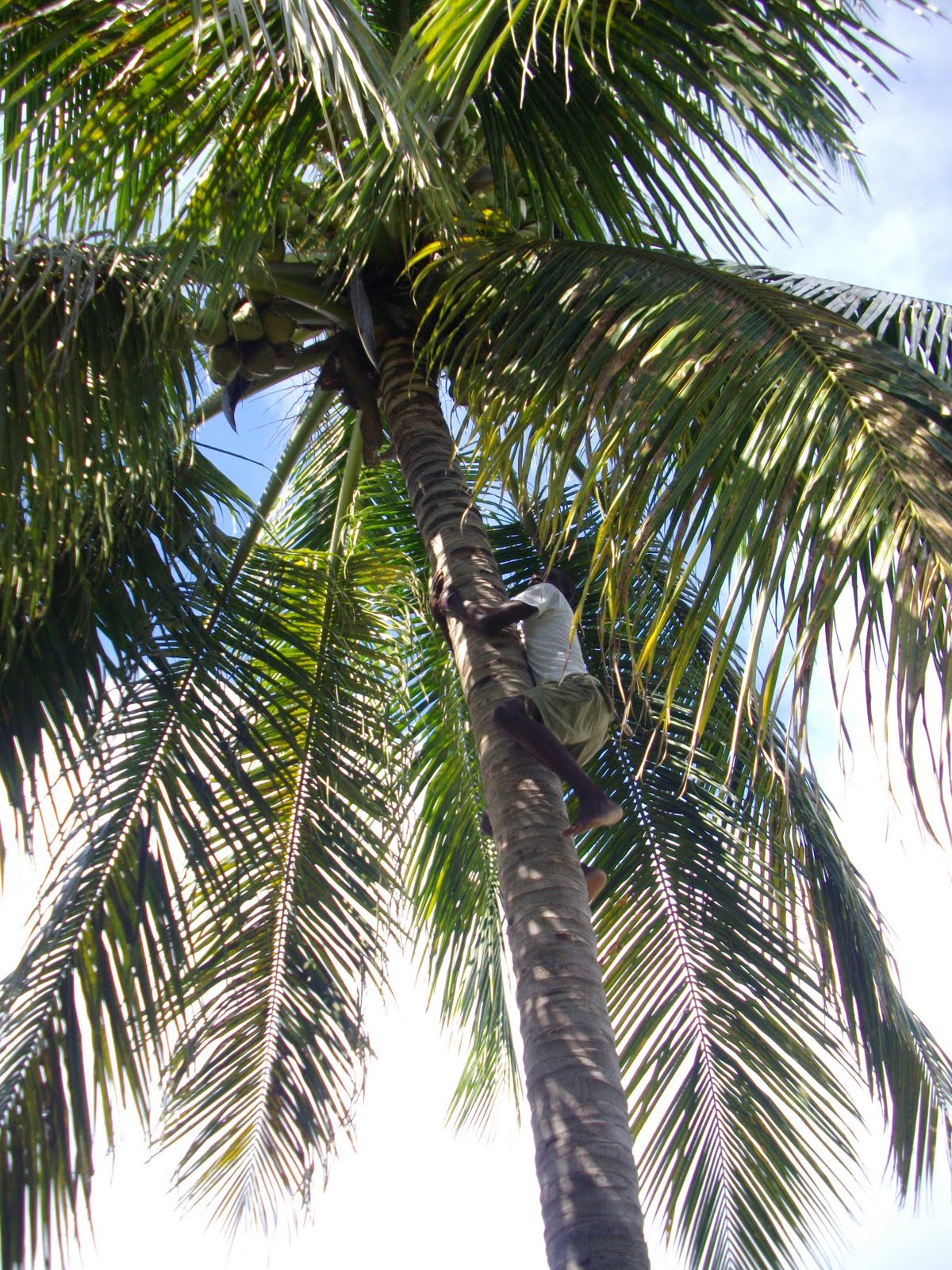
Leadership: Imitation, climbing the coconut tree

Photo by Robbie Pruitt


"pye kokoye"—What climbing coconut trees can teach us about leadership and discipleship.


In Haiti coconut trees are abundant. These tall trees present a challenge if you want to enjoy the delicious coconuts that they produce. Coconut trees can grow up to 30 meters tall, or about 98 feet. This makes getting to the coconuts at the top of the tree a very difficult and arduous task. In order for the Haitian people, or anyone else, to enjoy coconuts, someone has to climb the coconut tree. This can be a dangerous and daunting task.


Haitians are skilled climbers and can shimmy up a coconut tree barefooted, with machete in tow, with ease, skill, and precision. This is not a skill that an ordinary or average American possesses. How does someone learn a skill like this? There is hardly room for error forty to ninety feet up in a tree slinging a two foot blade at a cluster of coconuts.


If you visit Haiti an answer to how one learns to climb coconut trees comes into focus, and clarity can be gained. The Haitian people take great pride in learning and teaching and you can often observe a young Haitian boy or girl watching their parents or neighbors as they work. There is as much education going on in the normal day to day activities as there is during regular school hours. Young Haitian boys study their fathers as they climb the coconut tree; they watch and observe, they stand closely and study every move, they imitate their fathers.


Photo by Robbie Pruitt


Leadership and discipleship have everything to do with imitation. As leaders we are to be what we want to see in others, so that in imitating us, people look like what we want them to become. As leaders, we reproduce in others who we are. If we want to see in others what we would have them become, then we must exhibit these same traits ourselves. We must "climb the coconut tree of leadership” to develop leaders who can “climb the coconut tree of leadership.”


Jesus models this imitation for us in
John 5:19-20 when he said,
“Most assuredly, I say to you, the Son can do nothing of Himself, but what He sees the Father do; for whatever He does, the Son also does in like manner. For the Father loves the Son, and shows Him all things that He Himself does; and He will show Him greater works than these, that you may marvel.” Jesus imitates the Father. He does what he sees the Father doing. If we are to make disciples, develop leaders, and help lead others to Jesus, we must be doing what we see Jesus doing, through His power, work, and grace in us.


The Apostle Paul modeled this imitation as well, and imitated Jesus’ imitation in the above verses, in his ministry with the church in Corinth. In 1 Corinthians 11:1-3, Paul asked the Corinthians to “Imitate him, just as he also imitates Christ.” He goes on to say, “Now I praise you, brethren, that you remember me in all things and keep the traditions just as I delivered them to you. But I want you to know that the head of every man is Christ.”


Paul is exhorting the Corinthian church to do what he does as he imitates Jesus. This is effective only as long as Paul is imitating Jesus. His desire for the Corinthian Church and for us is that we remember the entirety of all he has taught us and that we recognize Jesus as the “head” or the leader that we should all be ultimately following and imitating.


May we "climb the coconut tree of leadership,” imitating Jesus, recognizing that others are watching us follow Jesus as we lead, and that they are eager to learn to follow Jesus and to lead as well.


Finally, may we rest in this blessing from Hebrews 6:9-12 as we imitate our Lord: “Beloved, we are confident of better things concerning you. . . For God is not unjust to forget your work and labor of love which you have shown toward His name, in that you have ministered to the saints, and do minister. And we desire that each one of you show the same diligence to the full assurance of hope until the end, that you do not become sluggish, but imitate those who through faith and patience inherit the promises.”


Bibliography


The New King James Version. Nashville : Thomas Nelson, 1982, S. Jn 5:19-20


The New King James Version. Nashville : Thomas Nelson, 1982, S. 1 Co 11:1-3


The New King James Version. Nashville : Thomas Nelson, 1982, S. Heb 6:9-12

Tuesday, November 16, 2010

Hands to the Plow

Photo By twoblueday gerry


When I was a kid, my Grandfather used to take me out to the country where he owns three acres of land. Pop planted a garden there almost every year. He used a motorized tiller to break up the ground to make it easier to plant the seed. I would watch him wrestle the steel beast and plow perfectly straight rows. Pop would place a focal point at the end of each row and would set his gaze on that focal point to make the rows straight. As I watched him, I remember thinking that one day I would be a strong man who would know how to plow a straight row with a tiller. I also remember when that day came. Pop taught me how to plow. He handed me the tiller and pointed out ahead to the goal. The steel beast shook me and I wrestled with it toward the row’s end. At one point, I looked back and the tiller turned and bucked and I had to wrestle it back to its place, making a crooked row and a mess out of the garden. Eventually, through the years, practice made perfect and the rows became straight and perfect.


Granddad also taught me who Jesus is. I saw Jesus in Pop way before I ever understood a single sermon this Baptist preacher ever preached. Pop lives a life committed to following the Lord. I have learned what it means to follow Jesus through watching Pop keep his eyes on Him. As it turns out, living for Christ and plowing have a lot in common. As Jesus says, “No man, having put his hand to the plough, and looking back, is fit for the kingdom of God (Luke 9:62).” When Pop put his hand to the plow, he never looked back. With Jesus as his focus, Pop’s rows have been straight through the field of life and he has shown many The Way.


Perfect Rows

(Luke 9:62)


Grandpa taught me

How to plow

In straight rows

Machine in hand

Eyes in front of me

Tilling the land

Perfectly plowed rows

Where my gaze is set,

My body goes


Eternity displays its fertile fields

And all that eternity knows

From heel dented mounds

And the sprinkling of seed

Spring forth growth and abundance

Of every plant, from every breed

No more lacking, no more need

Walking the straight rows

Hands running through the green

Into eternity as eternity is seen


My eyes set out before me

My hand to the plow

Never looking back

Gazing at Jesus now

Straight perfect rows

Into eternity

The way my Grandfather chose

My gaze toward my savior

Just like he taught me

To look to the cross and to eternity


© 2010, Robbie Pruitt

http://www.robbiepruitt.com/


“And Jesus said unto him, ‘No man, having put his hand to the plough, and looking back, is fit for the kingdom of God.’” –Luke 9:62

Tuesday, November 2, 2010

Rubble

Photo above by Ron Holt

As of October 2010, 2% of the rubble has been removed from Haiti after the January 2010 earthquake that crumbled that country. Observing the effects of this reality, the current state of Haiti, can make one feel helplessness and despair. Looking out over the vast devastation, the conditions of poverty, and the destruction is profound, sobering, and leveling. There is so much need and brokenness.

When my wife Irene and I were in Haiti recently, I wanted to fix the things that I saw. I am “a fixer” by nature. As I looked out over the landscape, the sinking feeling in my gut was a feeling of helplessness and despair. “There is just no fixing this.” I thought to myself. Just as I was thinking this, I felt as if God were speaking to me, “That’s right, you cannot fix this. You cannot even fix yourself. I can fix this. I will fix this. You cannot, but I can. You are not their saviour, you can’t be. You cannot even save yourself, because you are in the same condition, but I can. I can renew and restore Haiti and I can renew and restore you too!” This was a moving and powerful word from the Lord for me.

We live in a fallen and sin riddled world that is filled with destruction and disrepair. We live in a world that is in a constant state of decay. Our world is groaning (Romans 8:22).

The following poem, “Rubble,” compares the human heart condition, the result of sin’s rampant rule, with Haiti’s brokenness and destruction, due to fallen world we live in and the magnitude of sin’s consequences throughout history.

It is God that pardons, saves, restores, renews, and rescues. God is at work in His creation despite of sin and evil in the world, and it is God who will make all things new, including Haiti, and including the Haiti like destruction and devastation that is in me and you.

“The heart is deceitful above all things, and desperately wicked: who can know it?” –Jeremiah 17:9

Photo above by Ron Holt

Rubble
(Jeremiah 17:9)

I got rubble . . .
I got rubble
Down inside of me
Fists full of rubble
Heart full of rubble
Broken heart and trouble
I got torn canvas
Tarp shredded
And days dreaded
I got stench filled polluted air
Charcoal fire burning
And no loving care . . .
Shame and a blank stare
I got worn out clothes
Nowhere to go
Where my next meal comes from
. . . I don’t know
I got dusty shoes
No good news
So far faded to black
Can’t see the blues
I got crowded streets
Shredded sheets
And no one to meet
I got polluted water in my veins
Spotted and soiled and stains
I got carcasses and death and remains
Viruses of all strains
I got a Haiti as my heart
Because I played my part
I am sin’s destruction and death
Gasping for life and breath
I am shattered destruction
Condemned collapsed building
Nothing to offer and nothing to bring
Soiled and dirty, never clean

I am ruins and decay
Broken and in disarray
Dashed hopes and dismay
I am hurricane torn
Weathered and worn
I am exploited lands
And caught with red hands
I am earth quake rattled
Crushed and tattered
Crying out . . . smattered
I am rubble
I am rubble in streets
Crashes nearly avoided
And skipped heart beats
Aftershocks and broken infrastructure
Spilled out in rupture
I am muddied murky waters
And close dilapidated quarters
I am refuse and abuse
Left out alone and cut loose
I am resource depleted
Promises never delivered . . . defeated
Broken glass on the shore
Never having enough
And always wanting more
I am helpless and despair
No health care
I am a world apart unnoticed
Out of sight, out of mind, unaware
On my own, I am unfed, full of dread,
And left for dead
I am Haiti
There is no life independently
No life on my own you see
I am wearing down and washing into eternity
Erosion . . . corrosion . . . implosion . . .
I got rubble
I got rubble breaking down to ashes and dust
Dust storms and winds gust
I got Haiti blowing through me
My destruction before me
Endlessly . . . effortlessly . . .
Carelessly . . . recklessly . . .

© 2010, Robbie Pruitt


Psalm 107:18-22


“They draw near unto the gates of death. Then they cry unto the LORD in their trouble, and he saveth them out of their distresses. He sent his word, and healed them, and delivered them from their destructions. Oh that men would praise the LORD for his goodness, and for his wonderful works to the children of men! And let them sacrifice the sacrifices of thanksgiving, and declare his works with rejoicing.”


Revelation 21:5-7

“And he that sat upon the throne said, Behold, I make all things new. And he said unto me, Write: for these words are true and faithful. And he said unto me, It is done. I am Alpha and Omega, the beginning and the end. I will give unto him that is athirst of the fountain of the water of life freely. He that overcometh shall inherit all things; and I will be his God, and he shall be my son.”